• Skip to main content
  • Skip to footer

Wage Peace - Disrupt War

Strategic, bold, direct and discursive action to disrupt militarism in Australia and our region.

  • About Us
    • Making Change
    • Wage Peace Wins Global Peace Award 2023
    • Wage Peace, Disrupt War and Repair the Planet!
    • Smashing the Social License of an Industry Geared to Terrorise.
  • Campaigns
    • Disarm Australia
      • Demilitarise Education
        • BAE recruiting Year 6 kids
        • Demilitarise Education – Campaign Background Briefing
        • The military has invaded our classrooms.
        • Interrupting the Pipeline: Defence in STEM
        • Spotlight on UNSW
        • USyd Tied to Arms Industry
        • Demilitarise UQ: A Petition to UQ from an Autonomous Student Group
      • Stop Harms Dealers
        • ABC & Weapons Silence A Speech
        • Blockade Lockheed
        • Australia exports 155mm shell exports to Germany & the IDF.
        • No AUKUS: No Submarines!
        • Boeing is OUT OF CONTROL
          • Boeing, the Pentagon and Australian-based Propaganda Units
          • Boeing is a Weapons Corporation at UQ – Beware Boeing’s Wars
          • Trial of the Boeing Disrupters
        • Conversations with the Arms Dealers: Thales and the first of December
        • EOS – Just one more Merchant of Death
          • Is this justice? EOS arms deals to Saudi Arabia and UAE
        • Nioa Munitions: An excess of public money to fund police and the gun lobby
        • Nioa should rule out exporting weapons to Indonesia
        • Rheinmetall – making a killing
        • Stop Lockheed Martin
      • Legacy Campaigns
        • US out!
          • Fight to ditch the Aus-US Alliance
          • Close Pine Gap Website
          • Signing Up For War: The US Military Agreement With Australia You Probably Know Nothing About
        • Toxic SAS
          • SAS absorbed toxic US military culture
        • Whistleblowers
          • Support McBride – It’s About Exposing War Crimes
    • Frontier Wars
      • Frontier Wars
      • Frontier Wars Ceremonies
      • Boe Spearim’s Fabulous Frontier Wars Podcast – Must Listen!
      • Commemorating the Frontier Wars in Gimuy 2021
      • Frontier Wars – Lest We Forget 2021
      • Frontier Wars’ Desert Pea Wreath
      • Lest We Forget the Frontier Wars 2020 – online gathering
    • Peace In Papua
      • Peace In Papua
      • Peace In Papua – Thales, recall your bombs
      • War on West Papua
      • Make West Papua Safe, Australian Federal Police action
      • West Papua is Rising Up: Act now with Papuans to #MakeWestPapuaSafe
    • Disarm Police
      • Nine hours, no bullets!
      • NIOA – Arming the Intervention
  • Disrupt Land Forces
    • dlf 24
      • Report: Dangerous Policing DLF24
      • Journalist’s take on DLF 2024
      • Tactical Disruption Works
    • dlf 22
      • War Criminals need not apply; a summary of DLF22
      • Disrupt Land Forces 2022
      • Land Forces – A Killer of an Expo
      • Facilitating Exports: The Global Supply Chain and Landforces Brisbane
    • dlf 21
      • We massively disrupted the Land Forces weapons expo
      • Love against the machine – Land Forces 2021
      • Disrupt Land Forces – weapons company tour
  • Resources
    • Weapons Dealers in Australia: A Map
    • Peace Pod: an aural adventure in anti-militarist activism.
      • Get Your Armies Off Our Bodies: Trailer
      • Peace Pod launched!
      • Resources for Students
      • Resources for Teachers
      • Child’s Play? Militarism in the classroom
      • E5 Jangan Bunuh Kami Lagi / Stop Killing Us: West Papua Part 1
      • E6 Jangan Bunuh Kami Lagi / Stop Killing Us: West Papua Part 2
      • E8 We Need These Minds: MIlitarism in Universities
      • Revolving Doors, Corruption Gateways
      • War Stories
      • War Stories: BONUS – Afghan Peace Volunteers
    • References
    • Articles
      • The military industrial complex rides on the glamorous mythology of war
      • Doxxing and Security Culture
      • War = Peak Toxic Masculinity
      • War and Peace- articles by Andy Paine
  • Stop Arming Israel
    • Stop Arming Israel
    • Blockade Bisalloy: A Report from the ‘Gong
      • Bisalloy Makes Steel to Kill
    • F-35 Supply Chain
      • Taking Action Against Ferra and the F35
      • Nupress in the F35 Supply Chain – Newcastle
      • What’s Marand got to do with it?
      • Ferra Engineering, Boeing & the Queensland Government
    • Arms Embargo Now!
      • Nth Qld tungsten burns in Palestine
      • Harms Dealers: Thales in partnership with Israel Aerospace and Elbit.

Disarm Australia

PAVING THE WAY TO A NUCLEAR WASTE DUMP IN CENTRAL AUSTRALIA

A DECLASSIFIED AUSTRALIA SPECIAL INVESTIGATION – Part Two

It hasn’t received final approval yet, but already the company behind a proposed Central Australian toxic waste dump is bragging that the dump will take nuclear waste from “our strategic international partners”.

The company, Tellus Holdings, was revealed a month ago in Declassified Australia to be working with Amentum, a controversial US military contractor, to develop what had originally been described as a “salt mine” into a massive underground nuclear waste dump.

Tellus now says it envisions the Chandler salt mine and waste dump to be “the world’s first multinational deep geological repository for hazardous chemical and low-level nuclear waste”.

The nuclear waste dump, Tellus tells us, will take “international low-level radioactive waste [from] our strategic international partners”.

Tellus Holdings already operates Australia’s first geological repository for low-level radioactive waste at Sandy Ridge, 240 kilometres northwest of Kalgoorlie, which became operational in 2021.

Now, with advice from one of the US’s largest military contractors – which also manages a 400-strong workforce in Alice Springs providing support services to the US’s Pine Gap satellite surveillance base – Tellus is confident that its proposed waste dump will become a reality.

No approval for nuclear waste, at first

Tellus’s proposed Chandler Project received approval in 2017 for its environmental impact assessment (EIA) by the Northern Territory Environmental Protection Authority.

The EIA included approval for the permanent storage of so-called Naturally Occurring Radioactive Materials (NORM) up to exemption levels – the lowest level on the National Directory for Radiation Protection’s waste classification scheme.

NORM results from activities such as burning coal, making and using fertilisers, oil and gas production, and mineral sands and uranium mining.

The facility does not have approval to store any other forms of radioactive waste.

Despite this, Tellus has consistently described the prospective facility as approved to accept low-level radioactive waste; a category of radioactive waste that is well above the NORM exemption levels in Australia’s waste classification scheme.

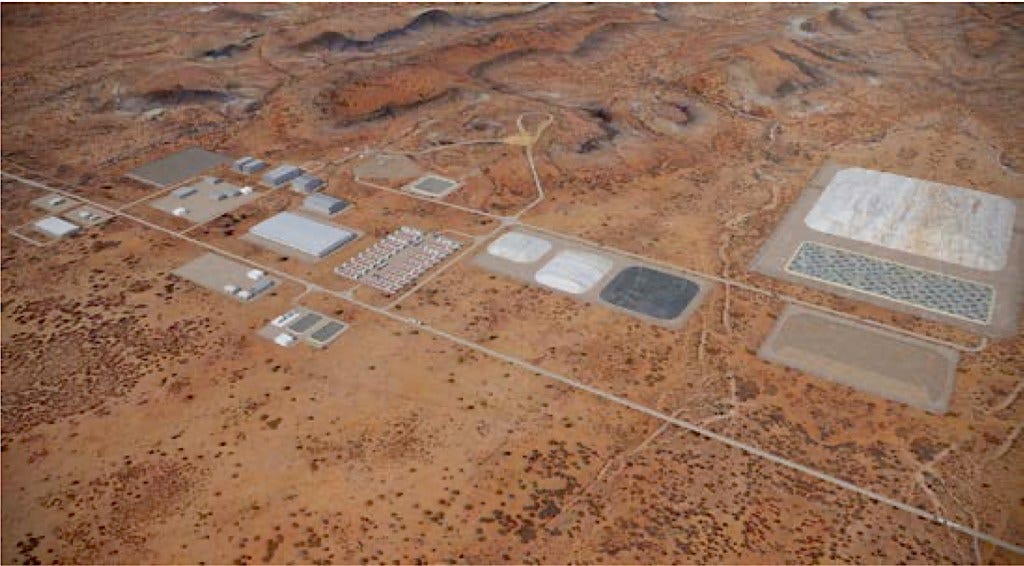
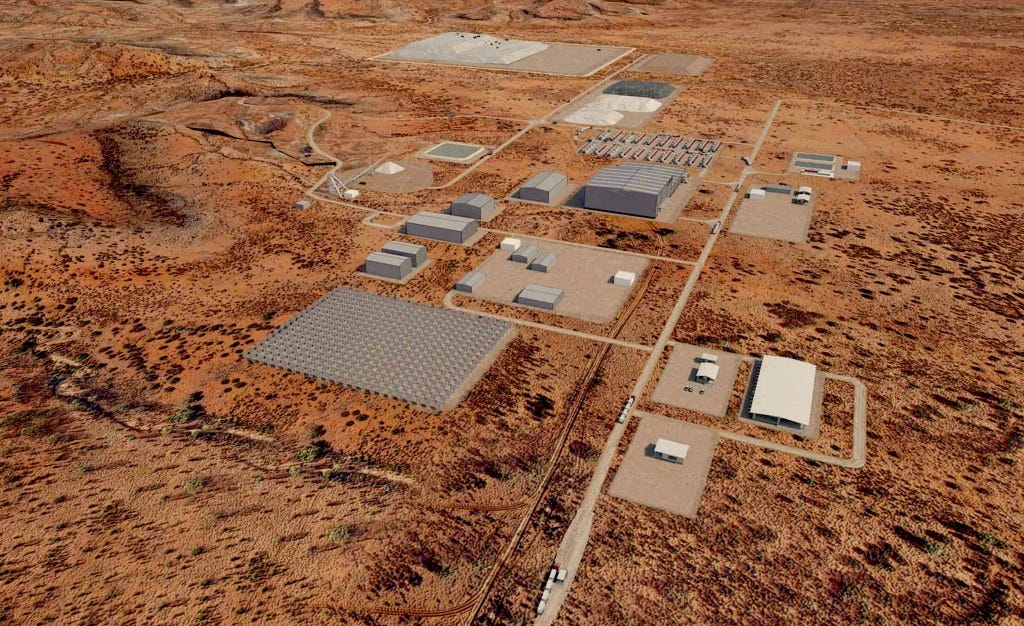
The planned massive deep underground international nuclear waste dump depicted here – along with a seperate 200 bed accommodation precinct, storage areas, warehouses, a transport interchange, plus an airport and an upgraded road network, lying atop a web of transport tunnels and excavated storage caverns over 800m deep – is to be located near the Aboriginal community of Titjikala, among the red sand dunes of the Simpson Desert, near the world famous Chambers Pillar and the ancient Finke River, 120 kms south of Alice Springs in Central Australia. (Image: Tellus Holdings)

The Northern Territory EPA’s assessment report describes the project components as including construction of an underground salt mine at a depth of up to 860 metres, permanent hazardous waste disposal vaults within mined-out salt caverns, temporary above-ground storage facilities for hazardous waste, and associated infrastructure like haul roads, access roads, and salt stockpiles.

From ‘no nuclear waste’ to nuclear waste ‘permission’

In its submission to the NT Environmental Protection Authority on the Chandler Project’s EIA, the Central Land Council (CLC), a statutory body under the Aboriginal Land Rights Act responsible for representing Aboriginal people in Central Australia, made clear the concerns of native title holders about the Chandler Project:

“Native title claimants have consistently expressed concern to the CLC about dangerous, poisonous and toxic waste being destined for permanent storage on their country and the issue of radioactive and nuclear waste has been raised at every meeting with the company.

“The company has repeatedly and consistently dealt with this concern by confirming that radioactive and nuclear waste will not be accepted at the repository”.

In 2021, Tellus made fanfare of voluntarily choosing to shelve its ‘major project status’ designation with the Northern Territory government in order to not pre-empt negotiations with native title holders.

By 2023, there had been a change to what materials the waste dump would be taking and what materials the traditional owners would now be accepting on their land.

In November 2023 after a decade of on-and-off consultation and two years after Tellus CEO Nate Smith described negotiations as “a bit stuck”, the company obtained permission from Southern Arrernte Traditional Owners for the construction of the Chandler nuclear waste dump on their Country.

Traditional owners entered into an agreement with Tellus as native title holders under the Native Title Act 1993. Under the Act, native title holders do not have veto rights over projects such as Chandler, but instead have the mere right to negotiate the terms of an agreement upon which the project may proceed.

Native title holders entered into an agreement under circumstances where the median weekly personal income in Titjikala is just $273, compared to $936 for the NT as a whole, and where successive racist government policies such as compulsory income management make many Indigenous communities heavily dependent on mining royalties.

There are a number of approvals and licences for the facility which remain outstanding, including its principal tenure Mineral Lease 30612. A final investment decision to allow the waste dump to proceed may still be years away.

Gaining trust through ‘disruption’

Tellus Holdings claims to have cracked the code in obtaining ‘social licence’ from local communities for hazardous waste storage facilities where Australian governments have for decades failed, approaching the issue with what Tellus describes as a “disruptor attitude”.

CEO Nate Smith has addressed the US Nuclear Regulatory Commission and the International Atomic Energy Agency’s annual conference on what is known within the nuclear industry as “consent-based siting”, and was the only international participant at the 2024 US Department of Energy’s “success in siting” roundtable.

“Tellus’s agreement in October 2023 with the Titjikala traditional owner group near Alice Springs… demonstrates social licence can be achieved for complex and potentially controversial projects if the right foundations are laid”, says Tellus’s submission to a parliamentary inquiry into nuclear power generation in Australia.

Key to achieving social licence, it claims, is building trust through engagement. In a half-hour appearance before the same parliamentary inquiry, on 17 December 2024, the Tellus CEO used the word “trust” seventeen times.

Likening frontline Aboriginal communities to children refusing to eat their vegetables, the Tellus CEO described his company’s community engagement ethos:

“[I]f you go out and announce, ‘This is what’s going to happen,’ and then you engage, it’s like telling your kids, ‘You’re going to eat those green beans, and now I’m going to tell you why they’re good.’ No. Tell them why they’re good first. You have to build the trust first”.

“Trust”, a Tellus webpage proclaims, “is the bedrock of our business”. This trust doesn’t appear to extend to fully informing native title holders of the waste streams, including from nuclear submarines and other military sources, that Tellus looks to be seeking to secure for its prospective Chandler Project.

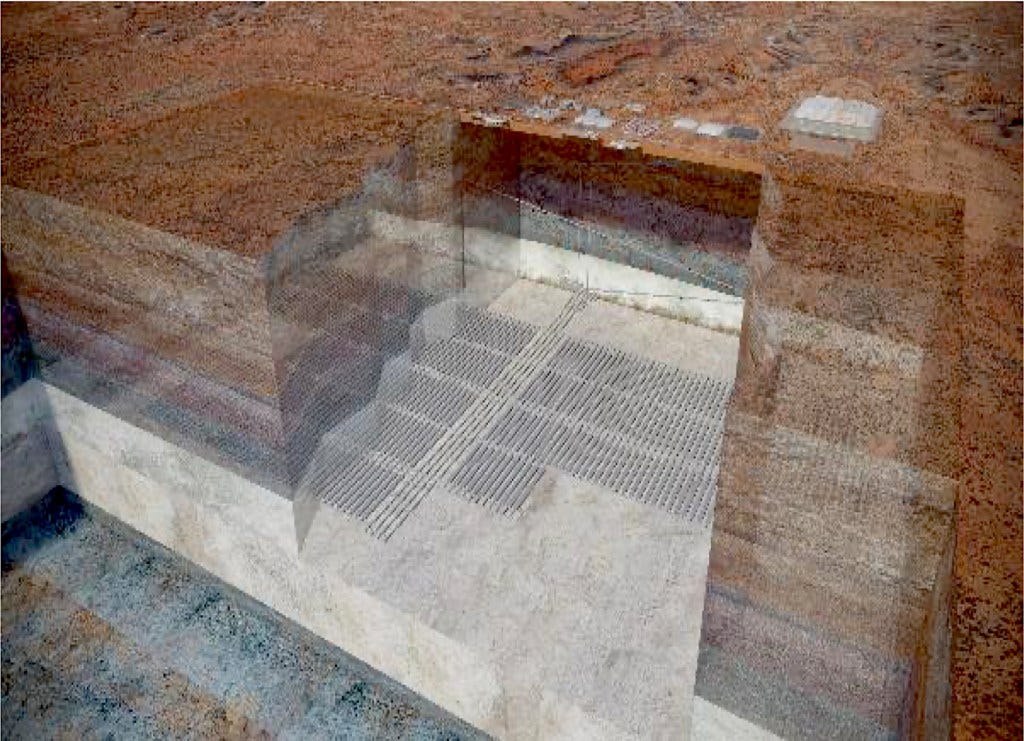
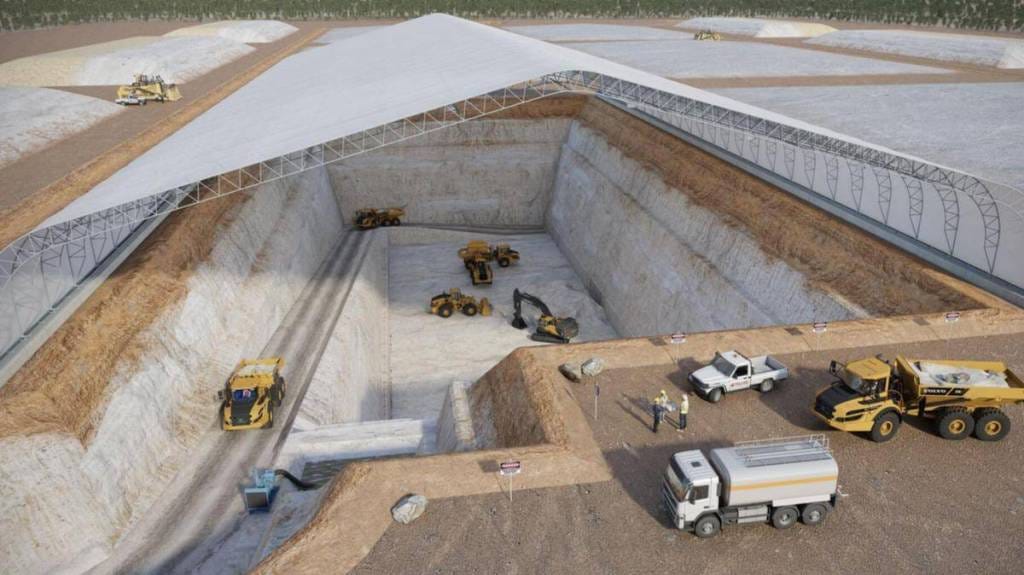
The massive underground nuclear waste dump planned for Chandler near the Aboriginal community of Titjikala south of Alice Springs in Central Australia, with its extensive 800m-deep storage chambers, dwarfs the Sandy Ridge low-level nuclear waste dump presently operating in Western Australia. See next image for comparison. (Photo: Tellus Holdings)

Tellus Holdings & AUKUS

Tellus Holdings bills the Chandler dump as “supporting Australia’s green energy transition” by providing a place to permanently store hazardous by-products associated with critical minerals mining.

However, the dump is also likely to become a repository for hydrocarbon wastes and by-products from oil and gas commissioning, as well as the radioactive materials derived from oil and gas extraction processes.

In his many public appearances, Tellus CEO Nate Smith is fond of saying “there is not a power source that exists in the world that doesn’t create massive amounts of low-level radioactive or chemical wastes”.

Smith claims that Tellus is “agnostic” with regards to Australia’s energy mix, though he recently appeared on a panel about “Australia’s nuclear future” convened by ‘Nuclear for Australia’, a pro-nuclear lobby group. Nuclear for Australia is partly funded by Australian millionaire Dick Smith and fronted by teenager Will Shakel, who has links to the Liberal Party.

Tellus’s US advisory partner in the Chandler Project, Amentum Holdings, doesn’t seem to share Tellus’s agnosticism. Offering plenary remarks at the 2025 Waste Management Symposia in Arizona, Amentum’s president for Energy and Environment, Mark Whitney, described nuclear and radioactive waste management as a “major component of our ability to expand global nuclear capacity”.

The Tellus CEO is less shy in telegraphing the role he says Tellus can play in getting the beleaguered AUKUS nuclear submarine program back on track, and is openly making a pitch for his company to receive AUKUS submarine waste.

“Tellus has the only management team in the world, government or private, that has run a successful radioactive waste disposal project end to end… That innovation is here for Australia’s use, and it is a valuable way to de-risk AUKUS or, if we choose, other nuclear program delivery”, he told Coalition and Labor MPs in December 2024.

In contradistinction to skeptical AUKUS commentators, Smith insists that the only thing preventing Australia from hosting nuclear submarines from as early as 2027 is the need for a site to store the nuclear waste they produce.

Fortunately, he says, Tellus’s already-operational Sandy Ridge facility, 240 kms northwest of Kalgoorlie, stands ready to accept the waste. “The near-term issue that’s threatening the AUKUS plan delivery is the low-level [radioactive waste], and that’s already solved so why reinvent the wheel”, Smith told Adelaide’s FIVEAA Radio.

Speaking before the Australian senate inquiry into nuclear power generation in December 2024, Smith told the committee that“it is the low-level radioactive waste, not the high-level radioactive waste, that will be the year-to-year issue in our lifetimes as AUKUS subs, as soon as 2027, and/or future reactors go through standard annual maintenance. I’m here to tell you that Australia already has the capability today to dispose of that at Sandy Ridge”.

The Chandler Project vs Tellus’s Sandy Ridge facility

Tellus’s Sandy Ridge low-level nuclear waste storage facility has been operational since 2021 and is described by the company as Australia’s “first commercial hazardous waste geological repository”.

When Tellus submitted the proposal for its Sandy Ridge facility to Western Australia’s Environmental Protection Authority in 2015, then CEO David van de Merwe “publicly stated the facility would not take nuclear waste and was only looking to take a small volume of medical isotopes”.

The subsurface Sandy Ridge low-level nuclear waste dump presently operating in Western Australia will be dwarfed by the massive deep underground nuclear waste dump planned for Chandler near the Aboriginal community of Titjikala in Central Australia. (Photo: Tellus Holdings)

When Tellus received conditional approval for its Sandy Ridge facility from the WA Environmental Protection Authority in 2017, it was for “non-nuclear low-level radioactive waste”. Seven years later, the current Tellus CEO Nate Smith insists that to overlook Sandy Ridge as a storage facility for low-level AUKUS submarine waste would be to “reinvent the wheel”. Tellus is now lobbying the Department of Defence for permission to store nuclear waste from AUKUS submarines.

Effectively a glorified trench dug into kaolin clay and covered by a dome resembling a bouncy castle, the Sandy Ridge facility cost $80 million AUD to build and is just 30 metres below surface level at its deepest.

Tellus’s Chandler Project, on the other hand, is conservatively projected to cost between $445 – $648 million AUD to construct. The Tellus CEO has said that the construction of the Chandler Project will likely be up to “10 times” the cost of Sandy Ridge.

Waste at the Chandler Project will be stored 860 metres below surface level – 205 metres deeper than New Mexico’s Waste Isolation Pilot Plant, which is used for storing transuranic radioactive waste derived from military sources. Yet Tellus Holdings claims that it intends for the Chandler Project to store low-level nuclear waste, just like Sandy Ridge.

In a significant moment during his appearance before the Parliamentary Inquiry into Nuclear Power Generation in Australia, Nate Smith was asked by the Labor MP Matt Burnell to describe the difference between a low-level nuclear repository and a high-level one.

In answering, Smith proceeded to effectively describe the basic differences between Tellus’s Sandy Ridge facility and its prospective Chandler Project (without naming the Chandler Project):

“What we are [at Sandy Ridge] is a near-surface repository. It’s an open-cut mine where we excavate about 30 metres down into a deep kaolin clay bed, and there’s granite underneath it. What we do is emplace waste in layers, almost like a cake. We compact it, we have a seal, and it sits throughout geological time. That can take low-level radioactive material, and in some cases, in the United States, they’re considering taking intermediate material in those types of facilities.

“To take high-level radioactive waste, you instead need to have a deep geological repository, not an open-cut mine. You have to burrow several hundred metres down into the earth, typically in salt or some hard rock like granite. There, you dispose of it deeper underground. Because of the type of radionuclides, you need additional safety, so that’s why you go deeper.”

Smith’s characterisation of the respective engineering requirements for low-level and high-level radioactive waste repositories echoes a description provided by the Sustainability Directory in a course on the fundamentals of radioactive waste disposal economics:

“Low-level waste (LLW), often composed of contaminated tools, clothing, and equipment, requires relatively straightforward handling and disposal, typically in near-surface facilities.

“Intermediate-level waste (ILW), containing higher concentrations of radioactivity or requiring shielding, often necessitates disposal in deeper repositories. High-level waste (HLW), primarily spent nuclear fuel from reactors or waste from fuel reprocessing, is intensely radioactive and generates heat, demanding robust, long-term isolation solutions like deep geological repositories”.

Tellus is going to the enormous cost and effort of building a new facility ostensibly to store low-level nuclear waste despite already operating such a facility in Western Australia.

The new site will require up to ten times the capital expenditure (before any cost blow-outs) of the existing Sandy Ridge facility, and stands to be vastly more complicated in engineering terms.

It is not clear why Tellus is planning to develop the Chandler facility for low-level nuclear waste storage when the company could, on the face of it, simply expand or replicate its existing Sandy Ridge facility at a much lower cost and with much less effort.

It is difficult to glean a clear answer from Tellus’s available commentary on the project. The following considerations can be made on what sort of hazardous waste may be stored at the Chandler Project, and its relationship to the burgeoning AUKUS military industrial complex.

Dumping the AUKUS waste

The Australian Submarine Agency has admitted that intermediate-level radioactive waste shed by nuclear submarines during routine operational maintenance will be stored in Australia.

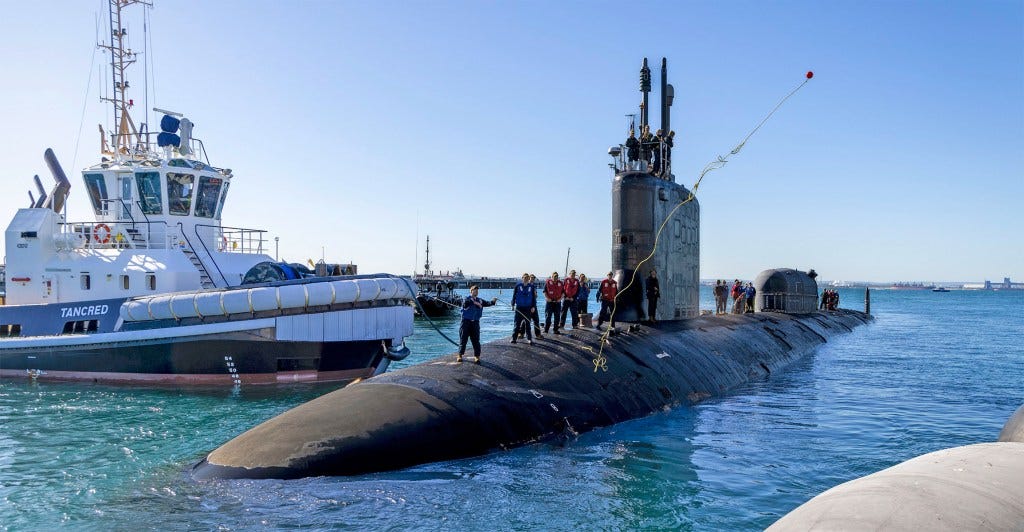
The United States now has its hands on its long-coveted Australian naval base to be built at HMAS Stirling on the outskirts of Perth, Western Australia. Here the US and UK will be servicing and maintaining their nuclear powered submarines, and expecting nuclear waste storage to be made available by their friendly ally. (Photo: US Embassy – Canberra)

Eventually, when these submarines are decommissioned, Australia will have to find a place to securely store the submarines’ nuclear reactors, containing weapons-grade uranium.

Australia is now a permanent base for UK and US nuclear submarines patrolling the Indian Ocean, using the HMAS Sterling base near Perth, for docking and maintenance of the submarines.

Given that the lifespan of the S9G nuclear reactors on the Virginia Class submarines is approximately 33 years, and the submarines projected to be stationed in Australia from 2027 will be between 3 – 23 years old, decommissioning in Australia could occur as early as 2037.

It appears that Chandler is being built with an eye to accommodating intermediate and high-level AUKUS nuclear waste, despite the fact that it is billed as a facility for naturally occurring radioactive material only.

No approval, no problem

Tellus’s Chandler Project does not currently have environmental approval to store nuclear waste of any kind. In order to accept such waste at its Chandler Facility, Tellus would have to seek amendments to its existing environmental impact assessment, or apply for a new one.

In addition to this, the company would need to pursue a new Indigenous Land Use Agreement with native title holders.

Tellus would also have to seek changes to or exemptions from the NT Nuclear Waste Transport, Storage and Disposal (Prohibition) Act 2004, which prohibits the disposal of waste containing radioactive material derived from the operation or decommissioning of a nuclear plant (including a nuclear reactor), from nuclear weapons activities, or from the conditioning or reprocessing of spent nuclear fuel.

The Central Land Council’s submission regarding Tellus’s environmental impact assessment for the Chandler Project raised the possibility of the Chandler facility accepting higher categories of radioactive waste once it is built, citing a risk that “once a geological hazardous waste repository is in operation there could be significant political pressure to broaden the acceptance criteria policy”.

At the recent Northern Australia Contaminated Land and Groundwater conference in Darwin, an attendee reports, a Tellus representative told conference attendees:

“The geology at Chandler would make it possible to store higher level radioactive waste”.

In response to a question on whether the Chandler dump was intended to store nuclear waste from international sources, the Tellus representative confirmed that it indeed was, and made it clear that Tellus was seeking to have government regulations modified to broaden waste acceptance criteria:

“We do feel that as good global citizens we should be helping to – if we’ve got the geology to offer a safe space, and a controlled, regulated environment for that waste – then we should play in that space.

“And absolutely, there is a huge commercial opportunity, particularly for the Northern Territory, if we were to do that. So a huge benefit in doing that, and we do have that guarantee of having a safe space.

“But we need the regulators, the public, and the politicians to agree to that. Just watch that space..”

Waste from expanding militarisation

Northern Australia is currently subject to a huge expansion in US military presence. For the fiscal year 2024/2025, northern Australia is “the top overseas location for U.S. Air Force and Navy construction spending, with more than $300 million set aside under the U.S. congressional defence authorisations for those years”, Reuters reports.

Over the next decade, the Australian government will spend $30 billion on “hardening and upgrading” northern military bases,“partly to meet US requirements and partly paid for by the United States”. This expanded presence will be accompanied by an expanded military waste footprint.

The Tindal Air Base, located just outside of Katherine, is currently undergoing a major upgrade that will include squadron operations facilities and maintenance infrastructure. The upgrade will allow for the permanent stationing of six US B-52 nuclear-capable bombers. B-52s, the last of which was manufactured 64 years ago, are notorious for requiring regular extensive maintenance that produces significant amounts of hazardous waste.

Maintenance of B-52s stationed at the Barksdale Air Force Base in the US, for example, produced “thousands of tons of powder, with dangerous trace metals and chemicals, from sandblasting and cleaning aircraft”, including chromium, arsenic, lead and cadmium.

This waste from the Barksdale Air Force Base provoked a significant scandal in the US that put the topic of outsourced hazardous waste management on US military bases in the public spotlight. Experts say that the US Department of Defence incentivised “shortcuts and outsourcing” in order to “preserve the Pentagon’s primary military mission”.

In making its pitch to the Australian Department of Defence for taking low-level nuclear waste from AUKUS submarines, Tellus played on the same instinct: “Government resources would be free [to] focus on mission critical challenges of AUKUS that do not yet have a solution”.

Encouraging the government not to provide oversight of hazardous waste management from military sources has proven to be highly problematic. An investigation into the US military’s use of contractors for hazardous waste disposal found that “in outsourcing this work, the military has often struggled to provide adequate oversight to ensure that work is done competently — or is completed at all”.

As the urgent drumbeat of war intensifies and the Department of Defence becomes increasingly preoccupied with “mission critical challenges”, so too do the risks from military waste clean-up work.

Tellus Holdings emphatically claims to have “solved” the inherent dangers associated with nuclear waste storage. However the flawed safety record of its contractor on the Chandler nuclear waste dump, Amentum, underscores the enduring threat of radioactive waste disposal, and the lack of transparency surrounding nuclear waste management on this continent.

With the Southern Arrernte community of Titjikala just 15 kms from the proposed Chandler nuclear waste site, any mistakes such as those that have already occurred with US military nuclear waste would be catastrophic for them, especially if ‘slippage’ occurs in terms of the kind of waste the facility accepts.

U.S. MILITARY CONTRACTOR BACKING AUSTRALIAN NUCLEAR WASTE DUMP

A DECLASSIFIED AUSTRALIA SPECIAL INVESTIGATION

In Alice Springs, Central Arrernte Country, the giant American military contractor, Amentum Holdings, is responsible for the day-to-day running of facilities for the secretive US-Australian Pine Gap satellite surveillance base. Now it’s involved in developing a proposed nuclear waste dump in Central Australia.

Declassified Australia can reveal that Amentum’s Alice Springs-based workforce of 400 people provides a myriad of support services to keep the ever-expanding base functioning, including infrastructure management, facilities operations, and maintenance services.

The proposal for the low-level nuclear waste dump comes as the federal government is seeking ways to manage and ultimately dispose of high-level nuclear waste from nuclear reactors in the proposed AUKUS submarines, as well as from other defence-related nuclear and hazardous waste, including visiting US and UK nuclear-powered submarines and warships.

As Declassified Australia exclusively reports, despite Amentum having a problematic record of nuclear waste management overseas, it is now involved in the nuclear waste disposal business in Australia.

Proposed Chandler Waste Facility

Massive US military contractor Amentum Holdings has been contracted to advise Australian hazardous waste company, Tellus Holdings, on the Chandler nuclear waste dump in Central Australia.

Tellus’s Chandler nuclear waste dump is proposed to be constructed within a salt formation on Southern Arrernte country 15 kms from the Aboriginal community of Titjikala and 120 kms south of Alice Springs.

The planned international nuclear waste dump depicted here – along with a seperate 200 bed accommodation precinct, an airport, and upgraded roads – is to be located near the Aboriginal community of Titjikala, among the red sand dunes of the Simpson Desert, near the world famous Chambers Pillar and the ancient Finke River, 120 kms south of Alice Springs in Central Australia. (Image: Tellus Holdings)

The Northern Territory Environmental Protection Authority’s assessment report for the Chandler dump describes the project components as including construction of an underground salt mine at a depth of up to 860 metres, permanent hazardous waste disposal vaults within mined-out salt caverns, temporary above-ground storage facilities for hazardous waste, and associated infrastructure like haul roads, access roads, and salt stockpiles.

In August 2024, Tellus announced that the company had contracted Amentum to conduct a Strategic Review of the project to assess timelines, feasibility, and potential international waste streams to be disposed of at the facility.

Sydney-based Tellus Holdings was founded in 2009 and describes its mission as “providing advance[d] end-to-end solutions for managing the world’s most challenging hazardous materials”. The company operates Australia’s first geological repository for low-level nuclear waste at Sandy Ridge, 240 kilometres northwest of Kalgoorlie, which started in 2021.

When Tellus’ American-born CEO Nate Smith, a former attorney at powerful Wall Street law firm Sullivan & Cromwell, was interviewed on ABC Radio last August, he cited the proximity of Amentum’s workforce based in Alice Springs as a strong reason for selecting Amentum to carry out the strategic review of the proposed nuclear waste dump.

Declassified Australia can exclusively reveal that at an NT Defence Week presentation held in Alice Springs in May 2024, an Amentum speaker stated that the company is contracted directly by the US government, and “employs roughly 400 people” providing services to the Pine Gap base.

According to an attendee at the event, the speaker said Amentum provides the operation services and maintenance of facilities, utilities management, renovation, security, environmental health and safety, catering, and housing services.

The company regularly posts ads for the employment of new contractors to provide services like cleaning, gardening and even swimming pool repair. On some days, the speaker said, there have been as many as 200 contractors for Amentum working on site at the spy base, 15 km south of Alice Springs.

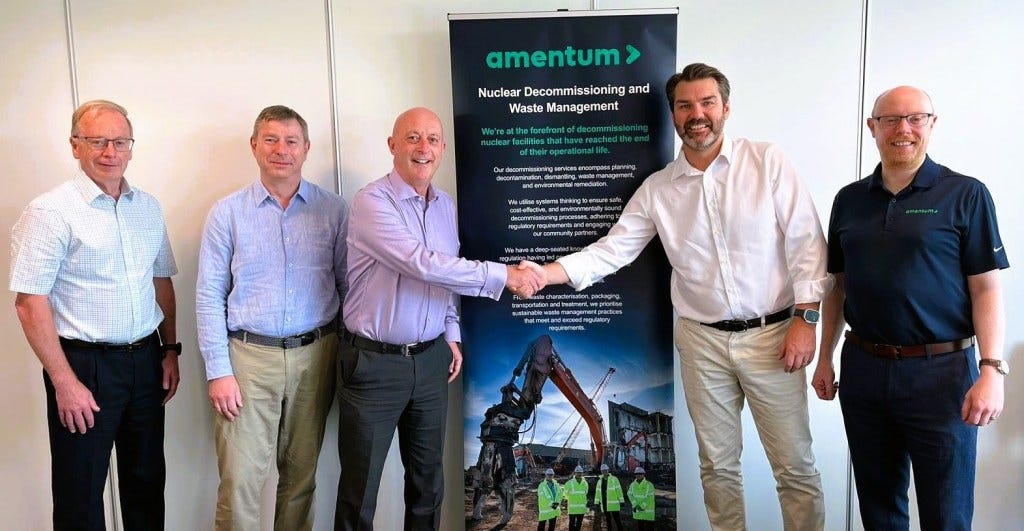
Happy days are here for Amentum Vice President Paul Pointon shaking hands with Tellus Chief Operating Officer Steve Hosking at a meeting in London in August 2024 to “deepen our partnership” and kick off the Strategic Review of the Chandler nuclear waste dump. Others from left to right, Amentum Senior Technical Advisor Dr Richard Cummings, Tellus Technical Director Radiation Safety & Project Assessments Dr Bill Miller, and Amentum Project Director Waste and Head of Consultancy David Rossiter. (Photo: Tellus Holdings)

Amentum and the US military

Amentum Holdings, based in Virginia, USA, is one of the US’s largest military contractors. The company employs 53,000 people across 80 countries, and provides services as diverse as chemical and biological weapons decommissioning, US army helicopter training, to running the Nevada Bombing Range and the Kennedy Space Centre.

As well as supporting the US’s most important satellite surveillance base outside the USA at Pine Gap, Amentum also works extensively in managing and maintaining US military facilities, primarily in West Asia and sub-Saharan Africa.

The company operates in Bahrain, Jordan, Kuwait, Saudi Arabia, Qatar, and the United Arab Emirates, where it provides operations and maintenance services on US military installations.

In Iraq, it manages and maintains US air force bases; and has previously operated in Afghanistan, where it maintained helicopters for the Afghan Air Force, and serviced airfields and trained Afghani police, until US forces evacuated the country.

In Somalia, Amentum is assisting in the construction of six new military bases, while in Ethiopia it is working to “enhance biosafety and biosecurity” at a vaccine lab and training facility.

Amentum is also involved more directly in training armed militias and military forces. In western Africa, the company operates in Benin, where it trains the country’s armed forces for ‘counter-terrorism’ operations.

However, Amentum’s activities have been subject to controversy, even by the standards of a global military contractor.

Amentum is providing training to three of Libya’s armed groups as part of attempts to unify major armed factions in Tripoli to ‘counter Russian influence’ within the country and across the African continent.

The company is currently defending a case before a US court on charges of human trafficking in Kuwait, through its predecessor companies AECOM and DynCorp. The companies allegedly participated in abusive practices against 29 interpreters working under US Army contracts during the US-led invasion of Iraq, “Operation Iraqi Freedom”. The abusive practices included forced labour under threat of deportation and arrest.

Amentum’s nuclear activities

In addition to its military contracts, Amentum has been working to support the development of nuclear reactors and facilities across a number of countries.

In the UK, Amentum has recently been selected as project manager for the proposed Sizewell C nuclear power plant on the Suffolk coast.

In South Africa, the company is working on extending the life of the country’s only nuclear reactor by 20 years. In the Netherlands, Amentum has been commissioned to undertake technical feasibility studies for two proposed new nuclear reactors.

It is on the American continent that Amentum’s reputation for managing nuclear facilities has suffered serious blows.

In 2012, Amentum formed the Nuclear Waste Partnership (NWP), a limited liability company, with BWX Technologies in order to bid on a US Department of Energy contract to operate and manage a US nuclear weapons waste disposal facility in the state of New Mexico, known as the Waste Isolation Pilot Plant (WIPP).

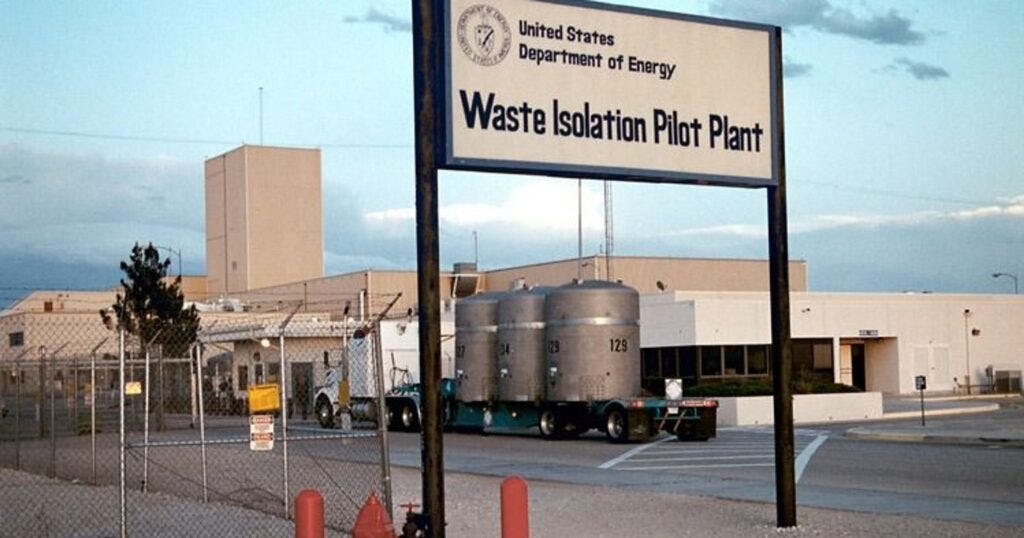
A truckload of nuclear waste arrives at the Waste Isolation Pilot Plant (WIPP) site shortly before the 2014 underground fire and the radiological leak and contamination incident. (Photo: US Department of Energy)

Amentum’s experience managing the WIPP nuclear weapons waste disposal facility is cited as one of the reasons Tellus selected Amentum as its partner to carry out the strategic review of the planned Chandler project.

However, Declassified Australia can report that over a 10-year period from 2012 to 2022, during which Amentum managed the WIPP facility, multiple highly hazardous incidents occurred.

The incidents, described by an expert on the Waste Isolation Pilot Plant as a “horrific comedy of errors”, transformed a facility once regarded as “the flagship of the [US] Energy Department” into an object of serious concern.

Amidst allegations of “gross mismanagement”, the dangerous incidents at the WIPP facility cost US taxpayers at least US$2 billion, and caused a three-year closure of the nuclear waste plant while redesign, repair, and remediation efforts were undertaken.

Nuclear weapons waste disposal

The Waste Isolation Pilot Plant (WIPP) in south-eastern New Mexico is, like Tellus’ proposed Chandler Project in Central Australia, located within a salt formation. Salt formations are generally considered ideal for the storage of nuclear waste because of their geological stability, capacity to dissipate heat generated by waste, low permeability to water and gasses, and self-sealing properties.

The WIPP site is massive. Its underground footprint currently includes ten excavated ‘panels’, each consisting of seven rooms, totalling 100 acres. An eleventh panel is under construction, and the US Department of Energy intends to expand the site to eventually consist of nineteen panels.

The facility has received more than 14,000 shipments of military nuclear waste since becoming operational in 1999. Its 800-strong workforce transfers transuranic waste received in drums to storage rooms 655 metres underground for permanent disposal.

The WIPP facility exclusively receives waste from the US’s nuclear weapons program, including tonnes of excess plutonium. Waste originating from 22 Department of Energy facilities, including the infamous Los Alamos National Laboratory (birthplace of the atomic bomb) is transferred to the WIPP facility for long-term storage.

There are proposals for the Waste Isolation Pilot Plant to take waste now classified as “high-level” once that waste has been ‘reclassified’ as transuranic (non-uranium) waste. This would pave the way for its storage at WIPP.

“Reclassification of nuclear waste could make disposal simpler and cheaper” is the breezy conclusion of one such proposal written by the editorial staff of Nature journal.

The site is legislated to receive 175,564 cubic metres of waste, and as of 2021, had reached 56.7% of its capacity.

Originally slated to begin closure in 2024, expansion plans and permit modifications have led nuclear watchdog groups to warn that what was only intended as a pilot plant is morphing into “Forever WIPP”.

The US Department of Energy itself now admits that “final facility closure could begin no earlier than 2083”.

Faulty design and handling at the Waste Isolation Pilot Plant

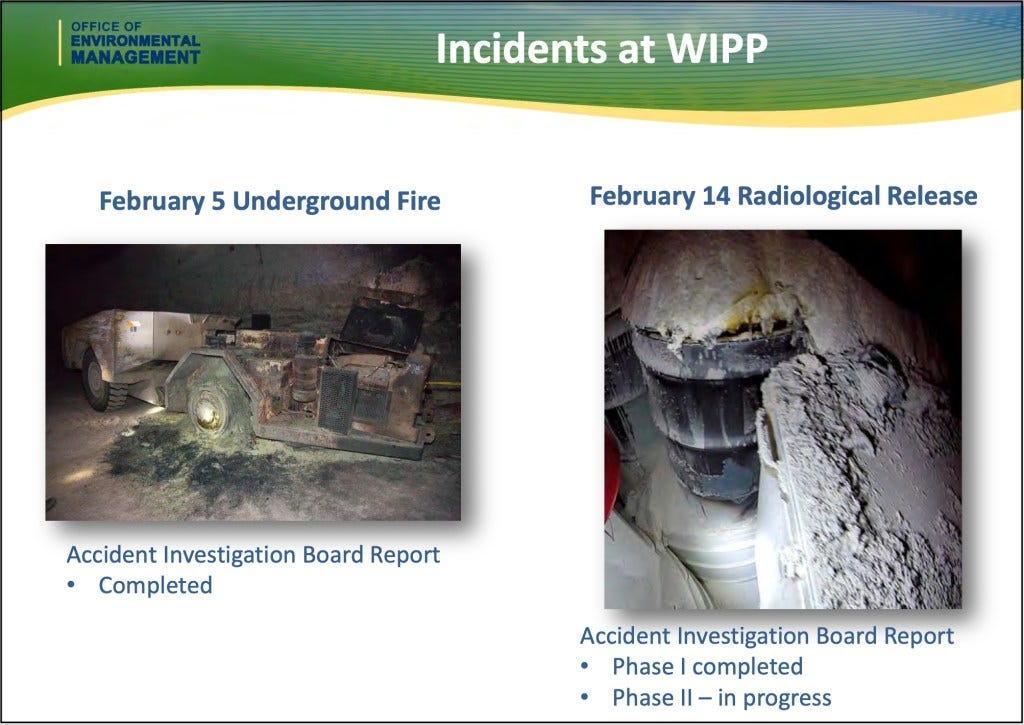
On February 5, 2014, less than 18 months into the Nuclear Waste Partnership’s management of the WIPP site, a truck caught fire within the facility, and six workers were hospitalised with smoke inhalation.

A subcontractor under the Nuclear Waste Partnership subsequently sued the company for “gross mismanagement of a major construction contract” involving reconstruction of an underground air-monitoring system that failed during the truck fire.

The subcontractor alleged that the Nuclear Waste Partnership (NWP), run by Amentum and BWX Technologies, “was such a disorganized project manager that it caused repeated delays and cost overruns, resulting in multiple breaches of contract”.

The US Department of Energy’s Office of Environmental Management investigated the fire and the radiological release of airborne radiation to develop a plan for recovery, stabilisation, clean-up, and temporary closure at Amentum’s WIPP facility in New Mexico, USA. (Photos: US Department of Energy)

The subcontractor claimed that NWP “used faulty designs that caused chronic problems and forced crews to redo large and expensive parts of the project”.

The faulty problems cited by the subcontractor included “a flawed design in hollow-roof panels requir[ing] an extensive redesign that dragged on for almost a year and at times forced work to shut down in other areas”.

Further, “[t]he building’s foundation had to be redesigned, requiring crews to move underground pipes they had already installed; and [a] defective design plagu[ed] the building’s control system”.

Less than a fortnight after the truck fire, on the 14th of February 2014, a barrel containing americium, plutonium, nitrate salts and organic kitty litter ruptured at the facility.

The rupture quickly spread contaminants “through about one-third of the underground caverns and tunnels, up the exhaust shaft, and into the outside environment”, exposing 22 workers at the WIPP facility to low levels of radioactive contamination.

Following the incident, the site was shuttered for three years. Clean-up efforts cost US$640 million, and a further US$600 million in operational costs were accrued during the years 2014-2017 while the site was being remediated and not accepting new waste.

In addition, the US Federal Government paid US$74 million to New Mexico to settle permit violations involving the radiation release and the truck fire two weeks earlier.

Once costs associated with temporarily storing the nuclear waste that had been destined for WIPP are taken into account (“hotel costs”, including the weekly inspection of more than 24,000 barrels of nuclear waste for leaks), the long-term cost of the incidents to US taxpayers is likely in excess of US$2 billion.

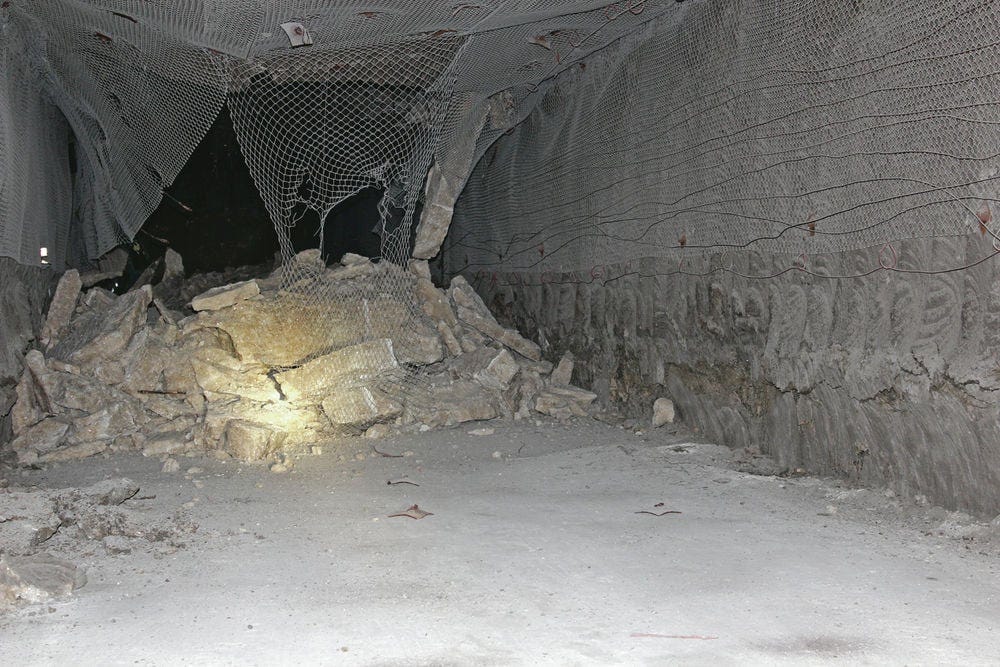
Huge blocks of salt rock fell from the ceiling and ripped through a metal retaining cage in a ceiling collapse in an access corridor underground in the WIPP nuclear waste facility, managed by Amentum. A WIPP spokesperson told the Santa Fe-New Mexican news site in October 2016 that the collapse, the second in a week, had been caused by natural ‘salt creep’, when the salt “naturally and continuously closes in on open spaces”. (Photo: US Department of Energy)

The WIPP site finally reopened in 2017 after three years of remediation efforts. The installation of a new ventilation system to replace the previous one contaminated in the incident of February 14, 2014 cost an additional $486 million USD, and was only completed in March 2025.

A safety analysis conducted prior to the WIPP facility becoming operational reassured regulators that the likely frequency of accidents involving the release of radioactive material at the facility would be once every 200,000 years.

However the two serious incidents of February 2014, resulting in a three year closure of the WIPP facility, occurred just 15 years into the site’s operation.

The US Department of Energy faced years of pressure from nuclear watchdog groups to end the Amentum and BWX partnership responsible for running the Waste Isolation Pilot Plant from 2012.

The Department finally decided not to renew Amentum and BWX partnership’s decade-long contract managing the WIPP nuclear weapons waste disposal facility. They exited in 2022.

The proposed Australian project

Back in Central Australia, Amentum’s strategic review of the Chandler Project is due to be completed imminently.

Neither Tellus nor Amentum responded to a series of questions put to them about aspects of the nuclear waste dump project.

With Tellus eager to push on, the massive international nuclear waste dump proposed for Southern Arrernte country 120 kilometres south of Alice Springs could commence as early as 2028.

PINE GAP IS A PLACE OF AGGRESSION

On December 1, 2023, two months into Israel’s escalating genocide in Palestine, Colombian president Gustavo Petro linked the unwillingness of wealthy global North countries to deal with capital-induced climate change to the management of global South populations deemed disposable because they were forced to migrate as a consequence of that unwillingness. Speaking at the UN climate conference, Petro warned that what is happening in Gaza is a blueprint for fascism globally in dealing with surplus populations: 

I invite all of you to imagine a combination of facts — the projection of the climate crisis in five or ten years and the current genocide of the Palestinian people. Are these facts disconnected? Or can we look at Gaza as a mirror of the immediate future? The unleashing of genocide and barbarism on the Palestinian people is what awaits the exodus of the peoples of the South unleashed by the climate crisis.

What we are seeing in Gaza is a rehearsal of the future.

That future is already here. Researcher of settler colonial technologies of repression, Alex Avina, perhaps describes the present monstrous state of affairs even more aptly. Avina writes: 

We live in an era of global disposability; that is, in an era marked by the power and ability of states to mark entire communities and peoples as disposable surplus populations. We watch in real time as Israel commits genocide in Gaza. We watch weaponised land and seascapes along with border police and border technologies like “smart” fences and drones killing migrants by the thousands. We watch how economic sanctions starve entire countries. 

Climate change, imperial wars, and the US fondness for collective punishment in the form of sanctions continue to generate more and more mass refugee displacement. Global north nations have responded by betting on more Apartheid walls, more border police, more surveillance, more genocide. A rather stark, uncomplicated choice thus emerges: do we side with the wall-builders and their Apartheid counterinsurgent technology that kills refugees in places like the Sonoran desert or the Mediterranean sea, or those who yearn to storm and smash walls with their dreams of a more just, free future for all?

We’re gathered here today at Kuyunba, about 500 metres away from the gates to the Pine Gap targeting facility. I say targeting facility and not spy base, because National Security Agency (NSA) documents and the Edward Snowden leaks prove that Pine Gap provides targeting data for US drone and missile strikes in places such as Pakistan, Afghanistan, Iran, Gaza, Yemen and Somalia, to name just a few. Pine Gap is a place of aggression, a place of counterinsurgency. Pine Gap is a place where people are made disposable in the most literal sense. Pine Gap is integral to the global US war machine. As a former US National Security Agency employee put it, drones are “like the tip of the spear but the rest of the spear is actually the global communications surveillance system” of which Pine Gap is one of the most important parts. 

“The repressors”, says Alex Avina, “the torturers, the killers, exchange knowledge, weapons and technology between themselves. They circulate best practices on how to manage, render disposable, and dispose of entire populations. It’s a lucrative business”. Some of these killers work here. It’s not a secret, we can name them – Raytheon, Boeing, Northrop Grumman and General Dynamics, IBM and Hewlett-Packard, Amentum. They all work out of this facility. 

We have committed to gathering here fortnightly to resist the violence of this installation and demand its closure. We resist the colonial violence of its imposition on Central Arrernte country. We resist the militarised and racialised surveillance in the Northern Territory, the incarceration of Indigenous youths across this continent, and the narrative warfare in our mainstream media and political offices against First Nations people that combined reproduce the conditions of colonial dominion that enable US military installations to be sited on this continent. It goes without saying that no permission was sought from traditional custodians, nor was permission granted, for the alienation of this land and the construction of a military base on it. 

We gather to resist the imperial violence that this base perpetrates abroad. In the 59 years that Pine Gap has occupied Arrernte country, the US has violently intervened in at least 80 countries. The base has provided targeting information and signals intelligence, facilitating illegal military aggressions from Vietnam and Cambodia to Yemen and Iran. There are no less than seven intelligence-sharing agreements between the US National Security Agency, which operates out of Pine Gap, and the Israeli Signals Directorate. Pine Gap provides intelligence to the Israeli military, which is committing the holocaust of our times in Gaza.

We gather to resist the US and Australian military build-up across northern Australia. For the fiscal year 2024/2025, northern Australia is “the top overseas location for U.S. Air Force and Navy construction spending, with more than $300 million set aside under the U.S. congressional defence authorisations for those years”, Reuters reports. Over the next decade, the Australian government will spend $30 billion on “hardening and upgrading” northern military bases, “partly to meet US requirements and partly paid for by the United States”. 

As we are gathered here today to struggle against militarism, colonialism and imperialism, the Talisman Sabre war games – a giant exercise in sabre-rattling – are taking place across northern Australia, Christmas Island, and Papua New Guinea. The games involve over 20,000 US troops and 10,000 Australian troops and have been described as “the most expansive and complex warfighting exercise ever conducted in Australia”. They pose a serious threat to the environmentally sensitive areas where they are taking place. The climate footprint of the exercises is likely to be enormous. There are at least 20 major warships transported to Australia for the war games, and dozens of military cargo aircraft deployed. The US military, the biggest player in these war games, is the largest institutional emitter of greenhouse gases on Earth and one of the world’s biggest industrial polluters.  

These war games are a significant health risk to nearby communities, many of which are Indigenous. A 2020 study of military training exercises in Puerto Rico found that “the sudden end of bombing practices is associated with a 56–79% decrease in the incidence of congenital anomalies of nearby populations”. 

One area where these war games are taking place is the Bradshaw field, in the Kimberlies, just outside of the majority-Indigenous community of Timber Creek. The Bradshaw Field occupies 871,000ha of rainforest, woodlands and grass plains on the lands of the Ngaliwurru, Jaminjung, and Nungali peoples. 

The story of the Bradshaw field shows how colonialism on this continent enables imperialism abroad. The Australian Strategic Policy Institute likes to boast that the “wide open space” of the Bradshaw field, one of the biggest military training areas in the world, is a key means of servicing Australia’s military alliance with the US and other so-called regional allies. The reinscription of northern Australia as a “terra nullius” available for violent and extractive uses is a precondition for these multi-national military exercises. 

The field was recently upgraded with “significant US investment” to enable training exercises like the Talisman Sabre war games, making it something of a hybrid training field and potential military base in the event of war fighting. 

Just last week we learnt that on at least two occasions this year, F-35 fighter jet parts have been sent from the RAAF base Tindal, just outside of Katherine, to Tel Aviv, Israel, to meet parts shortages there and allow Israeli F-35 jets to continue to carry out their sociopathic bombing campaigns on Gaza, southern Lebanon, Yemen, and Syria, to name just the places the Israeli military is currently bombing. 

Lockheed Martin’s F-35 fighter jet features heavily in UN Special Rapporteur Francesca Albanese’s most recent report on corporate actors profiting from the genocide in Palestine.  

“Post-October 2023, F-35s have been integral to equipping Israel with the unprecedented aerial power to drop an estimated 85,000 tons of bombs, much of it unguided, to kill and injure more than 179,411 Palestinians and obliterate Gaza”, – she writes. Apartment blocks, hospitals, universities, schools, bread lines, mosques and churches. 

The news of the F-35 components transported from Tindal to Tel Aviv ought to put to an end the Australian government’s shameful efforts to mislead us all and deny that it is transporting weapons to Israel. The Australian government should’ve ended its two-way weapons trade with Israel long ago. The Australian government should’ve ended intelligence-sharing from this facility long ago. The Australian government should’ve implemented an energy embargo long ago. The Australian government should’ve sanctioned Israel long ago. 

Across the globe, people are rising up against the genocide of Palestinians, against fascist governments and against militarism. As we gather here, anti-genocide and anti-war Palestine solidarity activists are gathered in Canberra for the first of a three-day event marking the opening of the 48th Australian parliament. They are gathered to demand that the Australian government end the two-way arms trade with Israel, end intelligence-sharing from this facility, end coal shipments to Israel, and sanction Israel now. We stand in solidarity, love and rage with them. To borrow the words of Taylor Miller – if Australian governments are so set on investing in war, in genocide, then our foremost task is to upend the reality that makes this horror permissible, and we must lock arms not only while envisioning an end to this genocidal economy—but across this desert, against these walls; towards liberation and return.

MILITARISM IN THE NT NEWSLETTER 7

MILITARISM IN THE NT NEWSLETTER

Hello! 

Welcome to the seventh edition of the Militarism in the NT newsletter. I plan to send out a newsletter with updates on US and Australian military plans and presence in the NT, and perhaps in northern Australia more broadly, roughly monthly. 

Further information on the context and intention behind this newsletter at the bottom of the text. 

Central Australian mine appears set to supply rare earths to US military industries

On October 20, Australian prime minister Anthony Albanese and US president Donald Trump announced that they were signing the United States–Australia Framework for Securing Supply in the Mining and Processing of Critical Minerals and Rare Earths. The framework, Anthony Albanese announced in a press release, would “deliver a US/Australia secured supply chain for critical minerals and rare earths, required for defence and other advanced technologies”. 

The agreement includes commitments by both countries to invest at least $1 billion USD each within six months into “priority” mining and processing projects in both jurisdictions, and commits both countries to set a floor price for critical minerals. The framework includes a raft of other measures including “streamlined” permitting processes and environmental deregulation in a context where 79.2% of Australia’s critical minerals mines are either on land where First Nations people hold native title rights, or where native title claims are pending. The geopolitical aim of the agreement is of course to reduce dependence on China for critical minerals and rare earths, which as of 2025 controls around 70% of global rare earth mining operations and approximately 90% of the world’s rare earth processing capacity. The agreement, gushes US national security think tank the Centre for Strategic and International Studies, advances “both nations’ ambitions for energy and minerals dominance”. 

The Critical Minerals and Rare Earths Framework comes nearly four months after the US Department of Defence (recently renamed the Department of War) announced that it was partnering with US rare earths company MP Materials to develop a “mine to magnet” supply chain in the US. MP Materials owns the Mountain Pass mine in California, the only operating rare earth mine and processing facility in the United States. Gina Reinhart’s Hancock Prospecting is a major shareholder, owning a 7.5% stake in the company. As part of that agreement, the US Department of Defence became the largest shareholder in MP Materials, announced that it would guarantee a floor price of $110 USD per kilogram for neodymium-praseodymium (NdPr) oxide, provide funding to expand MP Materials’ processing and magnet production facilities, and committed to buying all magnets from the company’s yet-to-be-built 10X Facility for a decade. 

Arafura Rare Earths’ Nolans Project

One of two projects on the Australian continent selected for equity investment by the Australian government as part of the agreement is Arafura Rare Earths’ Nolans project, located on Anmatjere country 135 kilometres north of Alice Springs. Gina Reinhart’s Hancock Prospecting is Arafura’s largest shareholder, with Reinhart nearly doubling her stake in the company to ~ 15.7% following the announcement of the Critical Minerals and Rare Earths Framework. The project will receive $100 million AU in equity investment, on top of the $840 million AU debt finance package it received from the Australian government in 2024, and the $200 million AU from Australia’s National Reconstruction Fund in 2025. Arafura Rare Earths was one of seven Australian companies to receive a Letter of Interest from the US Export Import Bank for a further $300 million USD in finance. 

At full production, Arafura’s Nolans Bore project will produce approximately 4,440 tonnes per annum of neodymium–praseodymium (NdPr) oxide – two rare earth elements generally used in conjunction in high-performance neodymium-iron-boron (NdFeB) magnets. This would be 4–5% of global NdPr oxide supply and up to a quarter of global supply coming from outside China, giving the project outsized geopolitical importance given China’s recent (now-deferred) export controls on rare earth elements, and prohibitions on rare earth elements going to overseas military manufacturers. 

At Nolans Bore, Arafura intends to operate an open-cut mine and separation facility. Ore will be processed on site into NdPr oxide, a process which is notoriously toxic. According to Arafura’s referral form under the Environmental Protection Biodiversity Act (EPBC) for the Nolans Project, “about 150 tonnes of uranium and 2,000 tonnes of thorium will be contained in residues produced at the RE [Rare Earths] process plant [on the site of the Nolans Project] each year”. This waste will need to be reprocessed or interred for long term storage in a radioactive waste dump such as Tellus Holdings’ proposed Chandler Project on Southern Arrernte Country, 120 kilometres south of Alice Springs. Both projects; the nuclear waste dump and the rare earths mine, appear to be prime candidates for the “national interest exemption” contained in Labor’s newly-released draft reforms to the Environment Protection and Biodiversity Conservation Act. Grounds for exemption include “Australia’s defence or security”, but the draft legislation also provides ample room for ministerial discretion in determining what constitutes “national interest’, including anything deemed beneficial to Australia’s relations with its “allies”. 

A Recent History of US Interest in the Project

It’s clear that the US government is keen for a portion of the rare earths mined at the Nolans mine to go to the US, even as much of the supply from the Nolans project is already contracted. Rare Earth Exchanges writes that “Arafura’s A$200 million infusion from Australia’s National Reconstruction Fund in 2025 was likely tied to future U.S. supply chain participation or off-take agreements not publicly disclosed, hinting at behind-the-scenes coordination with Washington”. 

In May of this year, John Parkinson of Rare Earth Exchanges noted that “U.S.-based institutional investors appear to be aggressively building positions in Arafura Rare Earths”, namely major US investment firms Vanguard, Fidelity, Dimensional Fund Advisors, Charles Schwab Investment Management, and Tidal Investments. These firms, wrote Parkinson, “may be anticipating that Arafura is earmarked for a future U.S.-aligned supply chain, possibly with off-take agreements, defence contracts, or strategic stockpile purchases”. 

“When heavyweight asset managers enter a pre-revenue critical minerals play en masse, particularly in a sector as geopolitically sensitive as neodymium-praseodymium (NdPr)”, Rare Earth Exchanges continued, “it often follows high-level briefings, signals from defense and trade authorities, or direct knowledge of pending strategic deals”. 

Source: Rare Earth Exchanges thread

At present, Arafura Rare Earths has binding offtake agreements with South Korean companies Hyundai and Kia for 43% of planned annual production of NdPr oxide from its Nolans mine (1500 tonnes/ annum); a binding agreement with German company Siemens Gamesa starting at 200 tonnes/ annum; a binding agreement with Luxembourg-based minerals trader Traxys Europe for 100 tonnes/ annum; and a non-binding agreement with General Electric Renewable Energy for an unspecified quantity of NdPr oxide annually. 

Source: Rare Earth Exchanges thread

In April of this year, Arafura’s managing director Darryl Cuzzubbo stated that “34% of the product from Nolans” remains to be contracted. Speaking from New York on October 25 after the United States–Australia Rare Earths Framework was announced, Cuzzubbo said of the Framework that “[e]ssentially, through the agreement, Australia is giving somewhat preferential treatment to its critical minerals, to the US”. 

While Arafura’s offtake agreements to date do not include US military industries (both South Korean companies Hyundai and Kia produce weapons systems and military vehicles), the mine’s inclusion in the United States–Australia Rare Earths Framework, alongside statements from Anthony Albanese and Donald Trump, suggest this is likely to change soon. 

Military Utility of Neodymium-praseodymium

Neodymium-iron-boron (NdFeB) magnets are core components for a wide range of contemporary military technologies. Each Lockheed Martin F-35 warplane, for instance, used extensively by Israel in its genocide in Gaza, contains 418 kilograms of rare earth elements, with neodymium-praseodymium making up a substantial portion of that mass. General Atomics’ MQ-9 Reaper drone, used by the US military to surveil Gaza throughout the genocide and to conduct drone strikes on Yemen for close to a decade, contains “10-15 kg of NdPr in its magnet-based propulsion systems and sensors”. Boeing’s Joint Direct Attack Munition; a technology that converts unguided bombs into precision-guided munitions; thousands of which have been provided to Israel throughout a bombardment that has leveled an estimated 84% of Gaza’s buildings, contains neodymium-praseodymium as part of the mechanism that guides the bombs. 

ABOUT THE MILITARISM IN THE NT NEWSLETTER

Many people are aware of US and Australian military presence in the NT, but perhaps less people are aware of just how much this military presence is intensifying as a perennially belligerent US prepares for war with China, and how much a new wave of extractivism in the NT is bound up with the US military industrial complex. For the fiscal year 2024/2025, northern Australia is “the top overseas location for U.S. Air Force and Navy construction spending, with more than $300 million set aside under the U.S. congressional defence authorisations for those years”, Reuters reports. Over the next decade, the Australian government will spend $30 billion on “hardening and upgrading” northern military bases, “partly to meet US requirements and partly paid for by the United States”. 

The Northern Territory jurisdiction has participated in the US/Israeli holocaust in Gaza via the provision of intelligence gathered at the Pine Gap Joint Defence Facility in Central Australia to Israel’s Signals Intelligence National Unit, and on to the Israeli military. The Northern Territory government is also busy renewing settler dominion at “home” by imprisoning unprecedented numbers of Aboriginal people. Politicians and the media have once again manufactured a racialised crime hysteria that is seeing Aboriginal children being brutalised by the police, prison wardens and an ever-expanding private security and surveillance apparatus. The mayor of Alice springs has called for the military to be deployed in the town. 

The newsletter is motivated by a desire to contribute to activist movements against militarism and extractivism on this continent, and the deprivations of ecological justice and land rights for First Nations they cause. It is conceived as a small contribution to the international fight against imperialism and an effort at solidarity with colonised and subjugated peoples struggling for liberation and justice. It is also intended to precipitate more reporting and investigative journalism on these issues on the part of independent journalists and journalists working within traditional media organisations. 

Please feel free to forward this newsletter to anyone you think might be interested and/or forward me their email address and I’ll add it to my mailing list for future newsletters. If you’d rather not receive this newsletter in the future, let me know and I’ll remove your email address from the list. 

MILITARISM IN THE NT NEWSLETTER 6

MILITARISM IN THE NT NEWSLETTER

Hello! 

Welcome to the sixth edition of the Militarism in the NT newsletter. I plan to send out a newsletter with updates on US and Australian military plans and presence in the NT, and perhaps in northern Australia more broadly, roughly monthly. 

Further information on the context and intention behind this newsletter at the bottom of the text. 

Russia cites US missile launch from the NT in statement announcing exit from nuclear treaty

When the Russian foreign ministry declared that Russia “no longer considers itself bound” by the 1987 Intermediate-Range Nuclear Forces (INF) Treaty on Tuesday, August 5, 2025, it cited the US military’s firing of the mid-range Typhon missile system from the NT during the recent Talisman Sabre war drills as one of the reasons for leaving the treaty. An SM-6 missile was fired by the US military from a Typhon missile system on July 16 from the Bradshaw field training area in the Kimberlies, sinking a cargo ship dedicated to the purpose in waters off northern Australia. 

The INF is an arms-control pact between the United States and the Soviet Union signed by US President Ronald Reagan and Soviet General Secretary Mikhail Gorbachev. The INF treaty banned all U.S. and Russian ground-launched ballistic and cruise missiles (both nuclear and conventional) with ranges between 500km to 5,500km, as well as their associated launchers. “By banning an entire class of weapons system”, writes the Australia Institute for International Affairs, “the treaty was more disarmament than arms control, and it closely articulated with the Reagan-Gorbachev grand vision of deep cuts in nuclear weapons”. The collapse of the INF treaty accelerates a new nuclear arms race that is already underway. 

The US exited the treaty in 2019, testing a ground-launched cruise missile just 16 days after leaving the treaty. The launch of the SM-6 missile from the Bradshaw Training Area using the Typhon missile system would have been a prohibited activity under the terms of the treaty. In abandoning the treaty, the Russian foreign ministry noted that “[i]n the Asia-Pacific, under the pretext of exercises in April 2024, a Typhon medium-range missile system was delivered to the Philippines, where it remains. A similar system was used in July 2025 in Australia during the multinational Talisman Sabre 2025 exercises”.

Where is the Typhon weapon system now? 

The 2023 Talisman Sabre war drills, the Guardian reports, provided a “discrete” opportunity for the US to preposition military equipment on this continent. Those war rehearsals “helped create new stockpiles of military equipment that were established in Australia after the drills ended in August”. “We’re looking to do this more and more,” said General Charles Flynn, the US army’s Pacific commander, at the time. 

Likewise, analysts in the Philippines have accused the US of “using [military] exercises to de facto deploy key weapons to the region”.

A Typhon weapon system transported to the Philippines in April 2024 as part of the Salaknib war games has remained in the country ever since, where it is within striking range of mainland China. US officials claim that the weapons system remains in the Philippines at the request of the Philippines government. A spokesperson for the Philippine military contradicted this claim, saying that it is “up to the United States Army Pacific (USARPAC) to decide how long the missile system would stay”. A Chinese defence spokesperson has described the missile deployment as “a strategic offensive weapon reminiscent of the Cold War”. 

A month after its deployment during the Talisman Sabre war drills, neither the US or Australian militaries have commented on where the system is now located. After the US exited the INF treaty in 2019, the Australian government stated that it would not allow this continent to be used for “land-launched mid-range missiles previously banned under the 1987 [INF]Treaty”. Prime Minister Scott Morrison said at the time “It’s not been asked of us, not being considered, not been put to us. I think I can rule a line under that”. 

The US military, however, has been clear that the transport of the Typhon weapon system to the Philippines and Australia is a stepping stone towards the “permanent basing” of the systems in the “Indo-Pacific region”. 

Precedent in the Philippines and following previous Talisman Sabre war drills suggests there is a likelihood the US will once again make use of the “discrete” opportunity war drills present for pre-positioning military equipment without occasioning too much public backlash to permanently station weaponry previously banned under international treaties on this continent. 

ABOUT THE MILITARISM IN THE NT NEWSLETTER

Many people are aware of US and Australian military presence in the NT, but perhaps less people are aware of just how much this military presence is intensifying as a perennially belligerent US prepares for war with China, and how much a new wave of extractivism in the NT is bound up with the US military industrial complex. For the fiscal year 2024/2025, northern Australia is “the top overseas location for U.S. Air Force and Navy construction spending, with more than $300 million set aside under the U.S. congressional defence authorisations for those years”, Reuters reports. Over the next decade, the Australian government will spend $30 billion on “hardening and upgrading” northern military bases, “partly to meet US requirements and partly paid for by the United States”. 

The Northern Territory jurisdiction has participated in the US/Israeli holocaust in Gaza via the provision of intelligence gathered at the Pine Gap Joint Defence Facility in Central Australia to Israel’s Signals Intelligence National Unit, and on to the Israeli military. The Northern Territory government is also busy renewing settler dominion at “home” by imprisoning unprecedented numbers of Aboriginal people. Politicians and the media have once again manufactured a racialised crime hysteria that is seeing Aboriginal children being brutalised by the police, prison wardens and an ever-expanding private security and surveillance apparatus. The mayor of Alice springs has called for the military to be deployed in the town. 

The newsletter is motivated by a desire to contribute to activist movements against militarism and extractivism on this continent, and the deprivations of ecological justice and land rights for First Nations they cause. It is conceived as a small contribution to the international fight against imperialism and an effort at solidarity with colonised and subjugated peoples struggling for liberation and justice. It is also intended to precipitate more reporting and investigative journalism on these issues on the part of independent journalists and journalists working within traditional media organisations. 

Please feel free to forward this newsletter to anyone you think might be interested and/or forward me their email address and I’ll add it to my mailing list for future newsletters. If you’d rather not receive this newsletter in the future, let me know and I’ll remove your email address from the list. 

  • Page 1
  • Page 2
  • Page 3
  • Interim pages omitted …
  • Page 11
  • Go to Next Page »

Footer

info@wagepeaceau.org

tel: 0403214422

SIGN UP DONATE
  • Facebook
  • Instagram
  • Twitter
  • YouTube
  • About Us
  • Campaigns
  • Disrupt Land Forces
  • Resources
  • Stop Arming Israel

Copyright © 2026 Wage Peace