A DECLASSIFIED AUSTRALIA SPECIAL INVESTIGATION
In Alice Springs, Central Arrernte Country, the giant American military contractor, Amentum Holdings, is responsible for the day-to-day running of facilities for the secretive US-Australian Pine Gap satellite surveillance base. Now it’s involved in developing a proposed nuclear waste dump in Central Australia.
Declassified Australia can reveal that Amentum’s Alice Springs-based workforce of 400 people provides a myriad of support services to keep the ever-expanding base functioning, including infrastructure management, facilities operations, and maintenance services.
The proposal for the low-level nuclear waste dump comes as the federal government is seeking ways to manage and ultimately dispose of high-level nuclear waste from nuclear reactors in the proposed AUKUS submarines, as well as from other defence-related nuclear and hazardous waste, including visiting US and UK nuclear-powered submarines and warships.
As Declassified Australia exclusively reports, despite Amentum having a problematic record of nuclear waste management overseas, it is now involved in the nuclear waste disposal business in Australia.
Proposed Chandler Waste Facility
Massive US military contractor Amentum Holdings has been contracted to advise Australian hazardous waste company, Tellus Holdings, on the Chandler nuclear waste dump in Central Australia.
Tellus’s Chandler nuclear waste dump is proposed to be constructed within a salt formation on Southern Arrernte country 15 kms from the Aboriginal community of Titjikala and 120 kms south of Alice Springs.
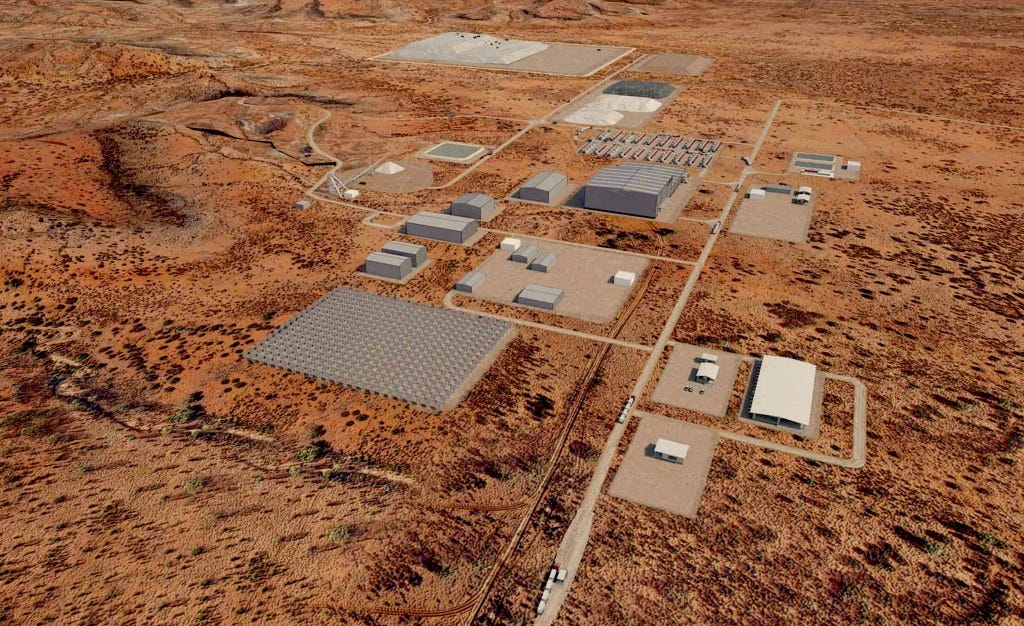
The Northern Territory Environmental Protection Authority’s assessment report for the Chandler dump describes the project components as including construction of an underground salt mine at a depth of up to 860 metres, permanent hazardous waste disposal vaults within mined-out salt caverns, temporary above-ground storage facilities for hazardous waste, and associated infrastructure like haul roads, access roads, and salt stockpiles.
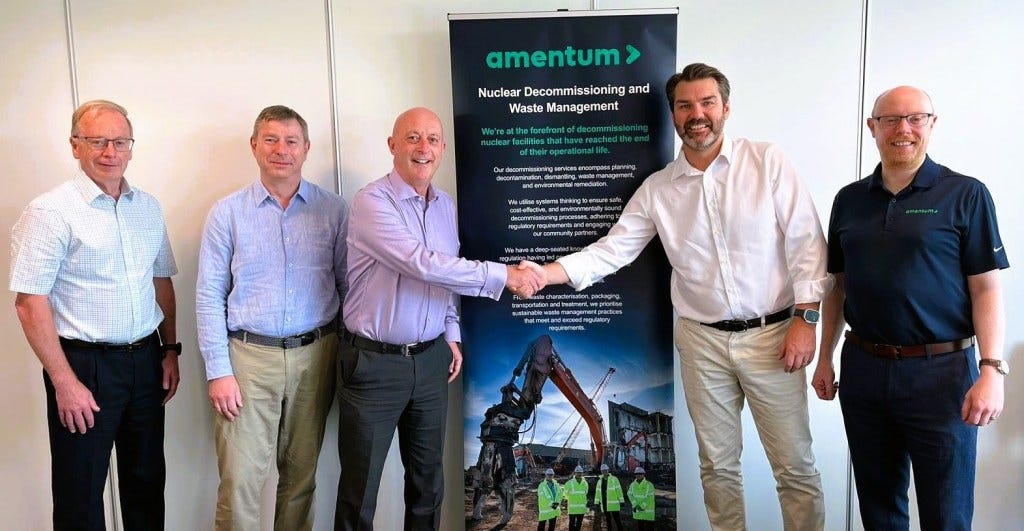
In August 2024, Tellus announced that the company had contracted Amentum to conduct a Strategic Review of the project to assess timelines, feasibility, and potential international waste streams to be disposed of at the facility.
Sydney-based Tellus Holdings was founded in 2009 and describes its mission as “providing advance[d] end-to-end solutions for managing the world’s most challenging hazardous materials”. The company operates Australia’s first geological repository for low-level nuclear waste at Sandy Ridge, 240 kilometres northwest of Kalgoorlie, which started in 2021.
When Tellus’ American-born CEO Nate Smith, a former attorney at powerful Wall Street law firm Sullivan & Cromwell, was interviewed on ABC Radio last August, he cited the proximity of Amentum’s workforce based in Alice Springs as a strong reason for selecting Amentum to carry out the strategic review of the proposed nuclear waste dump.
Declassified Australia can exclusively reveal that at an NT Defence Week presentation held in Alice Springs in May 2024, an Amentum speaker stated that the company is contracted directly by the US government, and “employs roughly 400 people” providing services to the Pine Gap base.
According to an attendee at the event, the speaker said Amentum provides the operation services and maintenance of facilities, utilities management, renovation, security, environmental health and safety, catering, and housing services.
The company regularly posts ads for the employment of new contractors to provide services like cleaning, gardening and even swimming pool repair. On some days, the speaker said, there have been as many as 200 contractors for Amentum working on site at the spy base, 15 km south of Alice Springs.
Amentum and the US military
Amentum Holdings, based in Virginia, USA, is one of the US’s largest military contractors. The company employs 53,000 people across 80 countries, and provides services as diverse as chemical and biological weapons decommissioning, US army helicopter training, to running the Nevada Bombing Range and the Kennedy Space Centre.
As well as supporting the US’s most important satellite surveillance base outside the USA at Pine Gap, Amentum also works extensively in managing and maintaining US military facilities, primarily in West Asia and sub-Saharan Africa.
The company operates in Bahrain, Jordan, Kuwait, Saudi Arabia, Qatar, and the United Arab Emirates, where it provides operations and maintenance services on US military installations.
In Iraq, it manages and maintains US air force bases; and has previously operated in Afghanistan, where it maintained helicopters for the Afghan Air Force, and serviced airfields and trained Afghani police, until US forces evacuated the country.
In Somalia, Amentum is assisting in the construction of six new military bases, while in Ethiopia it is working to “enhance biosafety and biosecurity” at a vaccine lab and training facility.
Amentum is also involved more directly in training armed militias and military forces. In western Africa, the company operates in Benin, where it trains the country’s armed forces for ‘counter-terrorism’ operations.
However, Amentum’s activities have been subject to controversy, even by the standards of a global military contractor.
Amentum is providing training to three of Libya’s armed groups as part of attempts to unify major armed factions in Tripoli to ‘counter Russian influence’ within the country and across the African continent.
The company is currently defending a case before a US court on charges of human trafficking in Kuwait, through its predecessor companies AECOM and DynCorp. The companies allegedly participated in abusive practices against 29 interpreters working under US Army contracts during the US-led invasion of Iraq, “Operation Iraqi Freedom”. The abusive practices included forced labour under threat of deportation and arrest.
Amentum’s nuclear activities
In addition to its military contracts, Amentum has been working to support the development of nuclear reactors and facilities across a number of countries.
In the UK, Amentum has recently been selected as project manager for the proposed Sizewell C nuclear power plant on the Suffolk coast.
In South Africa, the company is working on extending the life of the country’s only nuclear reactor by 20 years. In the Netherlands, Amentum has been commissioned to undertake technical feasibility studies for two proposed new nuclear reactors.
It is on the American continent that Amentum’s reputation for managing nuclear facilities has suffered serious blows.
In 2012, Amentum formed the Nuclear Waste Partnership (NWP), a limited liability company, with BWX Technologies in order to bid on a US Department of Energy contract to operate and manage a US nuclear weapons waste disposal facility in the state of New Mexico, known as the Waste Isolation Pilot Plant (WIPP).
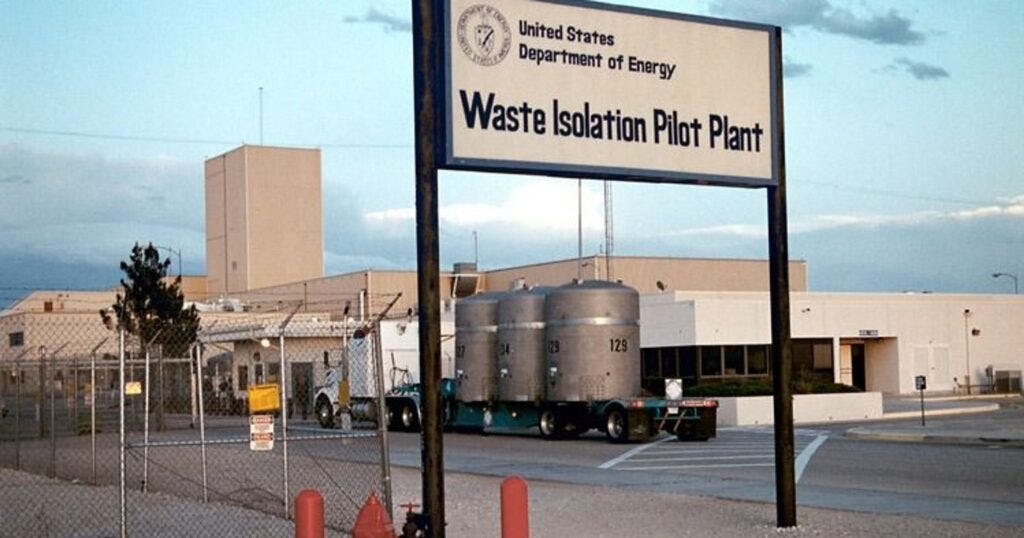
Amentum’s experience managing the WIPP nuclear weapons waste disposal facility is cited as one of the reasons Tellus selected Amentum as its partner to carry out the strategic review of the planned Chandler project.
However, Declassified Australia can report that over a 10-year period from 2012 to 2022, during which Amentum managed the WIPP facility, multiple highly hazardous incidents occurred.
The incidents, described by an expert on the Waste Isolation Pilot Plant as a “horrific comedy of errors”, transformed a facility once regarded as “the flagship of the [US] Energy Department” into an object of serious concern.
Amidst allegations of “gross mismanagement”, the dangerous incidents at the WIPP facility cost US taxpayers at least US$2 billion, and caused a three-year closure of the nuclear waste plant while redesign, repair, and remediation efforts were undertaken.
Nuclear weapons waste disposal
The Waste Isolation Pilot Plant (WIPP) in south-eastern New Mexico is, like Tellus’ proposed Chandler Project in Central Australia, located within a salt formation. Salt formations are generally considered ideal for the storage of nuclear waste because of their geological stability, capacity to dissipate heat generated by waste, low permeability to water and gasses, and self-sealing properties.
The WIPP site is massive. Its underground footprint currently includes ten excavated ‘panels’, each consisting of seven rooms, totalling 100 acres. An eleventh panel is under construction, and the US Department of Energy intends to expand the site to eventually consist of nineteen panels.
The facility has received more than 14,000 shipments of military nuclear waste since becoming operational in 1999. Its 800-strong workforce transfers transuranic waste received in drums to storage rooms 655 metres underground for permanent disposal.
The WIPP facility exclusively receives waste from the US’s nuclear weapons program, including tonnes of excess plutonium. Waste originating from 22 Department of Energy facilities, including the infamous Los Alamos National Laboratory (birthplace of the atomic bomb) is transferred to the WIPP facility for long-term storage.
There are proposals for the Waste Isolation Pilot Plant to take waste now classified as “high-level” once that waste has been ‘reclassified’ as transuranic (non-uranium) waste. This would pave the way for its storage at WIPP.
“Reclassification of nuclear waste could make disposal simpler and cheaper” is the breezy conclusion of one such proposal written by the editorial staff of Nature journal.
The site is legislated to receive 175,564 cubic metres of waste, and as of 2021, had reached 56.7% of its capacity.
Originally slated to begin closure in 2024, expansion plans and permit modifications have led nuclear watchdog groups to warn that what was only intended as a pilot plant is morphing into “Forever WIPP”.
The US Department of Energy itself now admits that “final facility closure could begin no earlier than 2083”.
Faulty design and handling at the Waste Isolation Pilot Plant
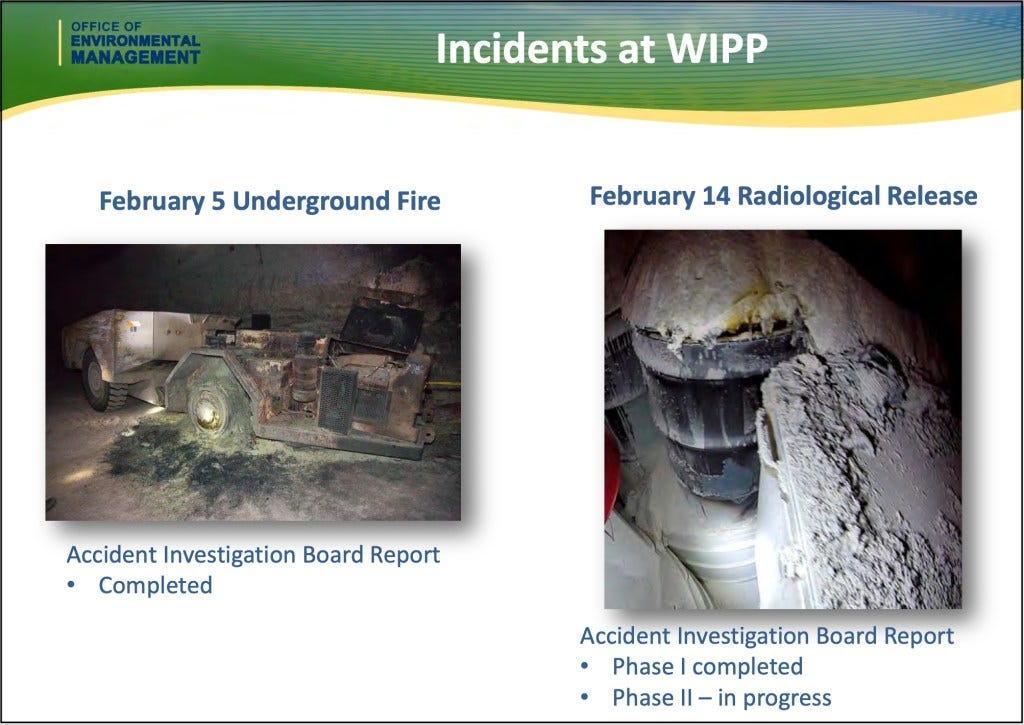
On February 5, 2014, less than 18 months into the Nuclear Waste Partnership’s management of the WIPP site, a truck caught fire within the facility, and six workers were hospitalised with smoke inhalation.
A subcontractor under the Nuclear Waste Partnership subsequently sued the company for “gross mismanagement of a major construction contract” involving reconstruction of an underground air-monitoring system that failed during the truck fire.
The subcontractor alleged that the Nuclear Waste Partnership (NWP), run by Amentum and BWX Technologies, “was such a disorganized project manager that it caused repeated delays and cost overruns, resulting in multiple breaches of contract”.
The subcontractor claimed that NWP “used faulty designs that caused chronic problems and forced crews to redo large and expensive parts of the project”.
The faulty problems cited by the subcontractor included “a flawed design in hollow-roof panels requir[ing] an extensive redesign that dragged on for almost a year and at times forced work to shut down in other areas”.
Further, “[t]he building’s foundation had to be redesigned, requiring crews to move underground pipes they had already installed; and [a] defective design plagu[ed] the building’s control system”.
Less than a fortnight after the truck fire, on the 14th of February 2014, a barrel containing americium, plutonium, nitrate salts and organic kitty litter ruptured at the facility.
The rupture quickly spread contaminants “through about one-third of the underground caverns and tunnels, up the exhaust shaft, and into the outside environment”, exposing 22 workers at the WIPP facility to low levels of radioactive contamination.
Following the incident, the site was shuttered for three years. Clean-up efforts cost US$640 million, and a further US$600 million in operational costs were accrued during the years 2014-2017 while the site was being remediated and not accepting new waste.
In addition, the US Federal Government paid US$74 million to New Mexico to settle permit violations involving the radiation release and the truck fire two weeks earlier.
Once costs associated with temporarily storing the nuclear waste that had been destined for WIPP are taken into account (“hotel costs”, including the weekly inspection of more than 24,000 barrels of nuclear waste for leaks), the long-term cost of the incidents to US taxpayers is likely in excess of US$2 billion.
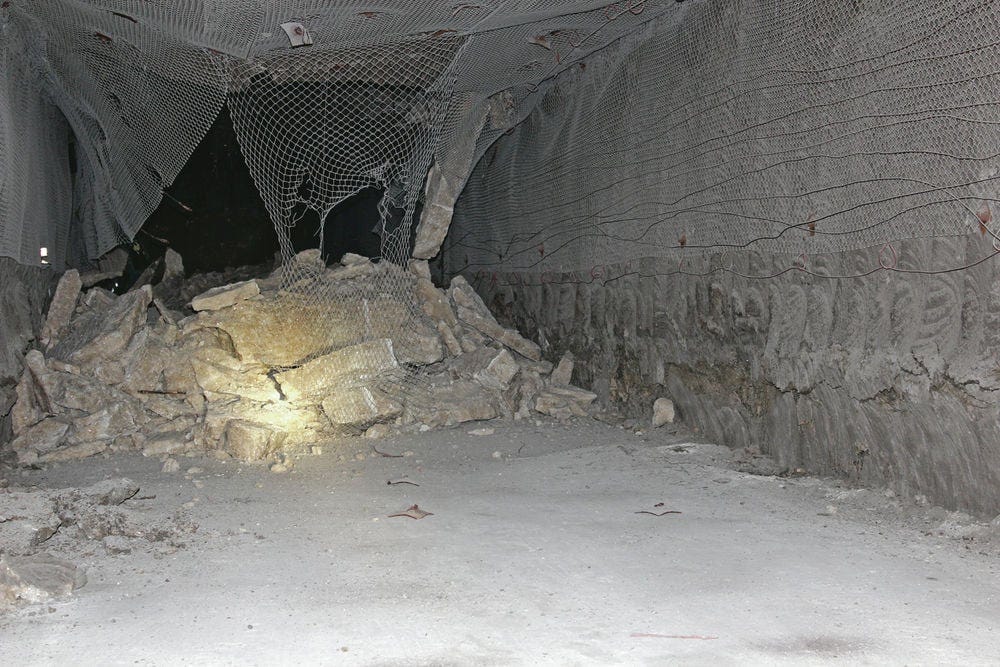
The WIPP site finally reopened in 2017 after three years of remediation efforts. The installation of a new ventilation system to replace the previous one contaminated in the incident of February 14, 2014 cost an additional $486 million USD, and was only completed in March 2025.
A safety analysis conducted prior to the WIPP facility becoming operational reassured regulators that the likely frequency of accidents involving the release of radioactive material at the facility would be once every 200,000 years.
However the two serious incidents of February 2014, resulting in a three year closure of the WIPP facility, occurred just 15 years into the site’s operation.
The US Department of Energy faced years of pressure from nuclear watchdog groups to end the Amentum and BWX partnership responsible for running the Waste Isolation Pilot Plant from 2012.
The Department finally decided not to renew Amentum and BWX partnership’s decade-long contract managing the WIPP nuclear weapons waste disposal facility. They exited in 2022.
The proposed Australian project
Back in Central Australia, Amentum’s strategic review of the Chandler Project is due to be completed imminently.
Neither Tellus nor Amentum responded to a series of questions put to them about aspects of the nuclear waste dump project.
With Tellus eager to push on, the massive international nuclear waste dump proposed for Southern Arrernte country 120 kilometres south of Alice Springs could commence as early as 2028.